Mastering Distance in Retriever Training: Building Marks for Success
Hello, fellow retriever enthusiasts! Welcome back to the Flying High Retrievers blog, where we're all about elevating your dog's performance in the field and beyond. If you caught our thread yesterday on the fascinating world of scent differences think the subtle nuances between mallards and pheasants, or even the distinctions among males and females of the same species you know how crucial it is to train with realism in mind. Those scent variations aren't just trivia; they play a huge role in how our dogs process and prioritize retrieves. Today, we're building on that foundation by diving into another key aspect of advanced training: the importance of incorporating major distance differences between marks.
Now, before you picture setups where every mark demands extreme range, let's clarify major distance differences don't necessarily mean relying on a fixed "short" like 50 yards for easy cues. The key is the relative contrast: training your dog to recognize that a significant disparity in distances provides the root of those easy cues. It's not about the absolute closeness of a mark, but how much closer it is compared to its longer counterpart. This approach helps prevent overrunning by teaching discrimination based on proportion, not just length.
Why Distance Differences Matter
In the heat of a hunt or trial, your retriever isn't dealing with uniform, predictable retrieves. Birds fall at varying distances, often with environmental factors like wind, terrain, or cover influencing the path. By mimicking this in training, you're teaching your dog to adapt on the fly. But here's the tie-in to yesterday's scent discussion: just as mallards carry a distinct, watery aroma compared to the earthier scent of pheasants (and let's not forget how drakes and hens add their own layers), distance adds another dimension to how dogs process information.
A long mark forces your dog to rely on memory, visual markers, and handler cues over immediate scent trails. Pair that with a shorter retired mark where the thrower is "hidden" after the throw and you're creating a scenario ripe for learning. The dog learns to differentiate based on distance cues: the far-off mark might demand a straight-line charge, while the closer one requires precision and control to avoid blasting past it.
Setting Up for Success: Practical Tips
Let's get into the how-to. Start by selecting a training area with open space fields or water edges work best for those epic long throws. Here's a sample drill that piggybacks on our scent insights:
The Long Haul Mark: Position a thrower in the field to launch a mallard (or dummy scented like one) out to 300-400 yards. Use a drake for that bolder scent profile we discussed yesterday, which can help your dog lock in from afar. This builds endurance and teaches the dog to commit to a line without second-guessing. As the bird falls, verbalize "Way out!" to cue the distance. Repeat it when showing the mark before calling for it, and right before sending with a louder, sterner tone on the dog's name no hand over their head for emphasis.
The Short Retired Counterpart: Immediately after, set up a shorter mark at 125-175 yards (still far, but significantly closer than the long one), and make it retired have your gunner step away after the throw. Opt for a hen pheasant here; its subtler, more elusive scent (as opposed to the punchier male) encourages the dog to hunt methodically rather than overrun. Cue this with "Easy!" when showing it (before the fall), as it falls, and before sending, like "easy (pause) easy (pause) Apollo (very gentle send)”. Send softly and quietly, with no hand over the dog's head this is a key "easy" cue to signal restraint.
Cue Emphasis: Run the long mark first to build momentum, then switch to the short one. This contrast highlights the relative distance as the root of easy cues. Over time, it trains them to gauge disparities instinctively, reducing overrunning a common issue where excitement overrides precision. The intensity of your send matters too: amp it up for the long one to convey urgency, but dial it way back for the short, promoting control.
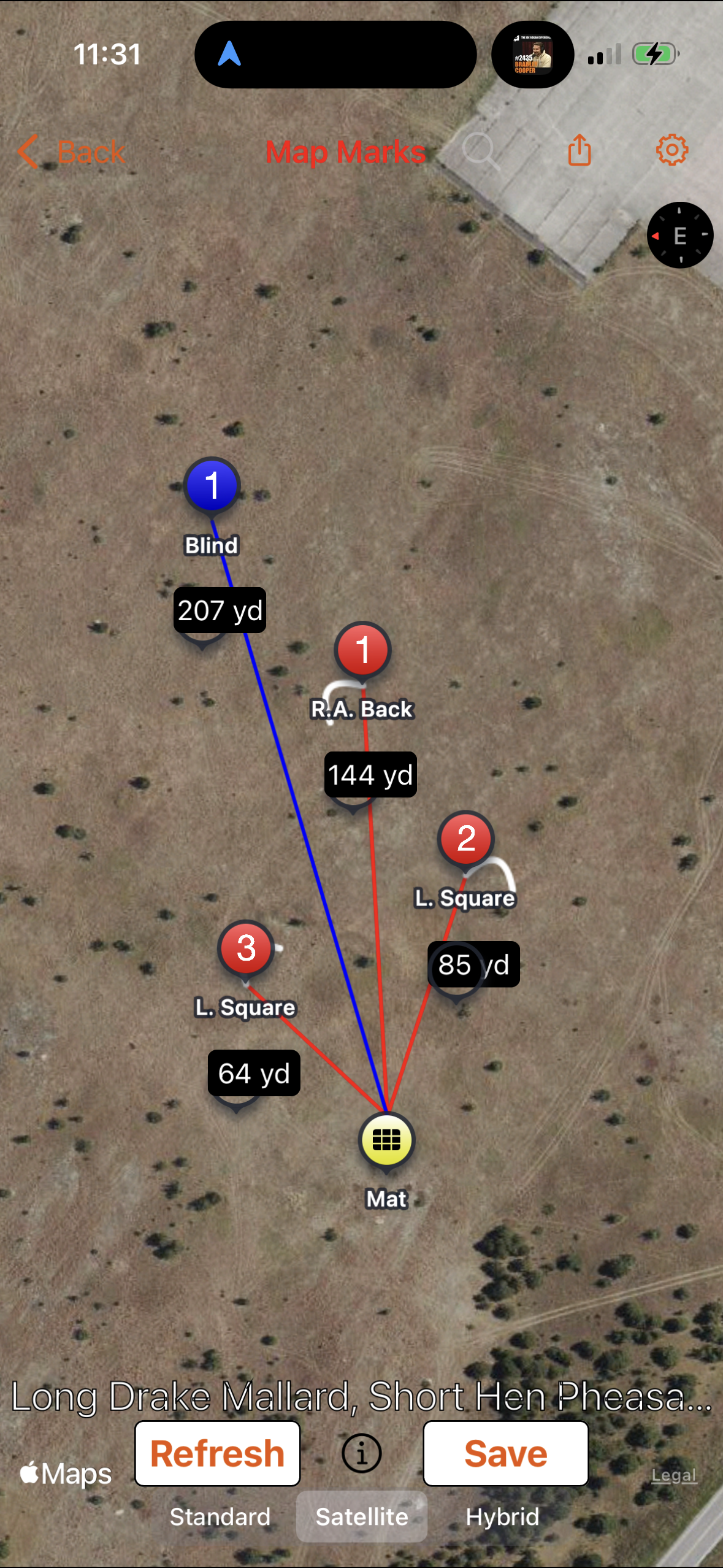
Remember, the goal isn't exhaustion; it's discrimination. By varying distances dramatically, you're reinforcing that not all marks are created equal, much like how scent profiles demand different hunting strategies. This approach also ties back to breed-specific traits in our Flying High lines our Labs and Goldens thrive on these mental puzzles, turning good retrievers into great ones. Note, in the attached image the distance difference is approximately 60 yards. This shows that the difference in distance is relative. For a short setup, the distance difference can be shorter. For a long setup the distance difference would be greater.
Preventing Overrunning: A Game-Changer
Overrunning happens when a dog, pumped from a long retrieve, barrels past a shorter one. It's frustrating in the field and can cost you a callback or a ribbon in trials. But with major distance differences in your setups, you're proactively addressing it. The long mark sets a "big picture" expectation, while the short retired one demands a reset. If your dog overruns the short mark and grabs the long one instead, stay calm on the next send for the short bird, make it even easier and quieter than before. Soften your voice further, skip the hand cue, and reinforce "Easy!" to dial back the intensity. Add in those scent variations mallard vs. pheasant, male vs. female and your dog learns to layer information: distance + aroma = smarter decisions.
We've utilized this approach in our training sessions and are seeing massive improvements in our dogs' performance.
Wrapping It Up
Incorporating major distance differences isn't about pushing limits it's about smart, layered training that builds on natural instincts and yesterday's scent lessons. Start small, scale up to those 300-400 yard beasts, and always pair with shorter retired marks for balance. Your retriever will thank you with better focus, fewer mistakes, and more success in the blind or at the line. Stay tuned for tomorrow, where we'll reinforce this idea through a discussion on primary, secondary, and ideal selection.
Got questions or want to share your training wins? Drop a comment below or hit us up on Instagram @FlyingHighRetrievers. Let's keep the conversation going after all, great training is a team effort!
Get Ready to Soar,
The Flying High Retrievers Team