Mastering Line Mechanics: Handling Your Retriever at the Line with Confidence and Control
Hello, retriever enthusiasts! Welcome back to the Flying High Retrievers blog. Building on our recent series, scent differences, major distance contrasts, and selection strategies (primary, secondary, and ideal), we now focus on a critical foundation: line mechanics. Effective handling at the line, including energy management, manners, and precise sends, directly supports strong marking and prevents common issues like overruns or switches. A composed, obedient dog at the line reflects focus, control, and partnership, setting the stage for success in the field, hunt tests, or trials.
Line manners start well before the birds fall. They encompass bringing your dog to the line calmly, maintaining proper positioning, managing energy, and sending with intentional cues. The objective is steadiness: a solid sit, full attention, and no movement until released.
Managing Energy Levels at the Line
High-energy dogs often arrive excited, bouncing, surging, or vocalizing. Low-energy dogs may appear distracted or hesitant. Balance is essential: channel high energy into focused intensity, and motivate low energy without overwhelming.
For high-energy dogs:
Walk deliberately to the line to avoid escalating excitement.
Incorporate brief "sit" or "heel" commands along the way to refocus.
Use a firm, positive tone to maintain composure.
For low-energy dogs:
Generate interest with quiet praise or a favorite bumper.
Keep sessions rewarding and concise to sustain engagement.
Avoid heavy corrections that could further reduce drive.
Bringing Your Dog to the Line with Manners
Manners training begins early and remains consistent. From kennel to line, expect calm heeling, no pulling or forging. Use a slip lead or flat collar for guidance, starting in low-distraction settings before progressing.
Key steps:
Release from the kennel only on "heel".
Heel to the line without forward surges; correct any immediately.
Sit at heel, aligned with your body, and await the setup.
The Essential Wagon Wheel Drill: Reinforcing Heel, Here, and There
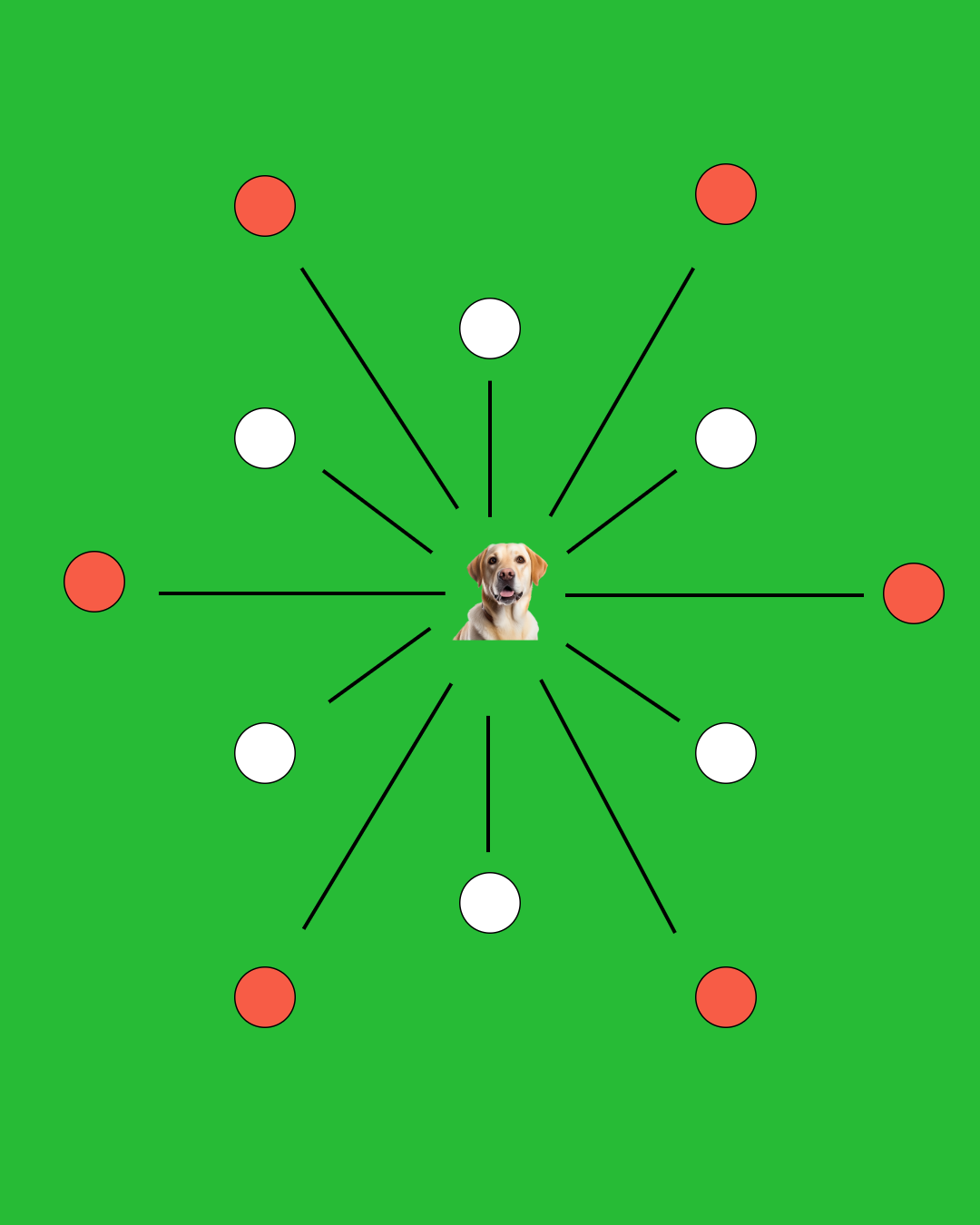
The wagon wheel drill excels at teaching precise alignment, responsiveness to "heel," "here," and "there," and overall line control. It fosters teamwork and prepares for accurate sends.
Setup:
Place bumpers in a circle around you and your dog (start with 4 at cardinal points, 10-20 yards out; expand as proficiency grows).
Position yourself and the dog in the center, dog at heel.
Execution:
Heel around the circle, using "here" to pivot right and "heel" to pivot left for adjustments.
When aligned to a bumper, use "there" or a quiet "good" to confirm focus.
Send only on command (e.g., "back") when perfectly lined.
Retrieve, return to heel, and continue around the wheel.
Regular wagon wheel practice sharpens fine-tuning and prevents misalignment.
Our illustration shows the advanced version with unmarked bumpers placed at approximately 20-30 yards and white bumpers at approximately 15 yards. When just starting out, we can disregard the unmarked bumpers and utilize solely the white bumpers, eventually progressing to "running past" the white bumpers to pickup the unmarked ones. This helps to further develop targeting by allowing a target to be "beyond" a white target, setting us up for success on poison and diversion birds in the future.
Correcting Creepy Dogs
Creeping, inching forward on the sit, often arises from excitement overriding obedience, particularly in high-drive dogs. Address it immediately and consistently: no retrieve if creeping occurs.
Effective approaches:
Deny the retrieve: Have the thrower pick up the bird/bumper.
Re-heel the dog, reinforce "sit" or "heel," and retry.
Use a tab for light correction on forward movement or a low-level e-collar nick if needed.
Build progressively: Begin with low-excitement singles, then advance to multiples.
Reward solid sits with praise and the retrieve.
Consistency turns creeping into a non-issue.
Sending Cues: Hand Over Head for Emphasis and the Crucial Adjustment for "Easy" Birds
Sends must align with the bird's demands, tying into our distance and selection discussions.
For long or emphasis birds:
Place your hand over the dog's head as a clear signal for a committed, powerful send.
Use a stern, louder tone on the dog's name (e.g., "Apollo!").
This conveys urgency and directs high energy straight.
For short retired "easy" birds:
No hand over the head, keep it soft and understated.
Use a gentle "easy (pause) easy (pause) Apollo" with a quiet, soft send.
This encourages restraint and helps avoid overruns.
A vital note on overruns: If you send for an "easy" bird early and the dog overruns it (often picking up the long bird instead), the next send for that short retired bird must be even easier, softer, and gentler. When the previous volume and intensity sent them long, dial it back further, less drive, quieter cues, to reinforce control. This is especially crucial in a trial: if your dog overruns the retired hen pheasant and grabs the long mark, it leaves a "bullet in the gun" to return for the short bird. A calmer, softer send increases the chance of a clean pickup without escalating the issue.
Practical Tips for Success
Uphold high standards: Never reward poor manners.
Proof in varied settings to handle distractions.
Incorporate wagon wheel as a regular warm-up.
Remain patient, improvements come with steady practice.
Solid line mechanics create a reliable, confident retriever. A well-mannered dog at the line enhances marking, handling, and overall performance. Stay tuned for tomorrow's post, where we'll dive into microadjustments before sends, including gunner recognition, target recognition, and why both matter. Plus, the key to aiming for an "under the arc" line instead of straight to the bird.
Questions or experiences to share? Leave a comment below or message us on Instagram @FlyingHighRetrievers. Training thrives through collaboration!
Get Ready to Soar,
The Flying High Retrievers Team